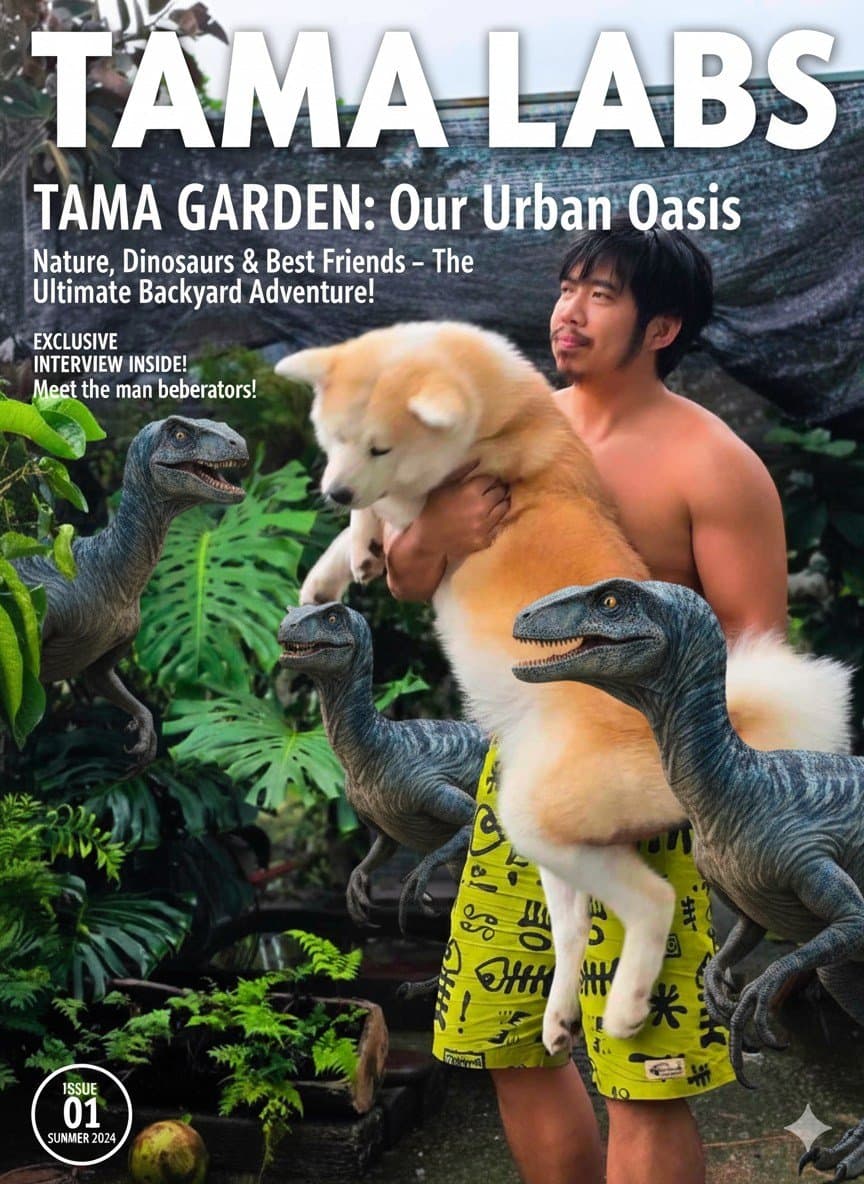
About Tama Garden
Tama Garden — a preservation kennel for Japanese Akita Inu and English Orpington chickens, founded by Elle & Mai of Tama Garden in 2020. Based in Rayong, Thailand.
อ่านภาษาไทย →Tama Garden
Tama Garden, full name Tamahagane Garden (玉鋼ガーデン), is a preservation kennel focused on genetic conservation, founded in 2020 and operating in Rayong, Thailand.
The kennel's central purpose is the preservation and refinement of the Japanese Akita Inu under the AKIHO standard (Akita Inu Hozonkai, the breed's principal preservation society in Japan) and the English Orpington under the Poultry Club of Great Britain (PCGB) standard. The work places the long-term integrity of conformation, genetics, and the spiritual character of each breed above short-term commercial considerations.
The Founder
The kennel is run by Elle & Mai of Tama Garden — a two-person partnership whose work began from an interest in genetics and a commitment to caring for animals at a level of structural and lineage detail rarely seen at the consumer end of the market.
Since establishment in 2020, the kennel has bred over fifty Akita Inu in Thailand and developed specialty Orpington lines — including Black Star, Blue, Splash, Isabel, Lavender — along with experimental varieties within the kennel's Super Orpington programme.
The operation is intentionally small — a two-person team — with hands-on care, predominantly home-cooked diets (commercial feed forms only a small percentage), and a monthly investment exceeding one hundred thousand baht to sustain the standard of care.
"I chose to write this piece myself, because I want anyone reading it to feel that there is still a 'human' who has studied, understood, and actually written this for you — not just an AI."
— Mai of Tama Garden, Our Akita Inu, Part 1
Philosophy
The work at Tama Garden is forged around three convictions.
One — Type is King
In every pairing and selection, the kennel holds to the principle Type is king — structure and conformation are the foundation; color and patterning can be developed and refined later. Selection grounded in good structure builds a lineage that endures.
Two — Spirit is the Breed
For the Akita Inu, a good pairing does not consist merely of producing the prescribed external characteristics. The dog must carry Kan-i (悍威 — dignified valor) and Ryōsei (良性 — good nature) as the AKIHO standard requires — qualities the breeder must understand in practice, not only on paper.
The same principle applies to the English Orpington. Under the PCGB standard, a good Orpington must be calm, tame, and friendly to humans — not skittish, not aggressive. Sound temperament is a foundational requirement of the breed, and it is the reason the Orpington has remained a household-suitable fowl in Britain for more than a century.
Three — The Ecosystem is the Tool
The kennel does not treat its dogs and chickens as objects separate from their environment. The two species are part of a system that must remain in balance — the dogs protect the chickens from predators, the chickens provide food and help manage insects, the system works together for the health and quality of life of every species within it.
Method
Standards Applied
- Akita Inu — Akita Inu Hozonkai (AKIHO) standard, 2005 revision, including the spiritual qualities of Kan-i, Ryōsei, and Soboku. Read more on the AKIHO standard.
- English Orpington — Poultry Club of Great Britain (PCGB) and The Orpington Club standards. Read more on the PCGB Orpington standard.
Genetics
- Use of Stack Recessive Methodology to develop rare Orpington color varieties such as Lavender and Isabel.
- Calculation of the Coefficient of Inbreeding (COI) using Sewall Wright's method before each planned pairing, to reduce the risk of overly close line breeding.
- Maintenance of diverse genetic sources — both Japanese mainline (for Akita) and traditional European lines (for Orpington).
Records
The kennel maintains a continuous Breeder's Diary, recording findings, problems, and solutions as they emerge — both to advance the long-term work and to share with others walking the same path.
"This is a notebook that probably no one will open right now. But someday it might be very useful to whoever is looking for a path to develop a living thing or to build a complete ecosystem on their own land."
— Mai of Tama Garden, Breeder's Diary, Part 1
Location
Primary site: Rayong Province, Thailand.
In the near term, the kennel will be relocating to Phitsanulok to expand operating area and strengthen long-term preservation capacity. Progress will be documented in the Journal.
View location on Google Maps →
Contact
For enquiries, requests for additional information, or to arrange a visit, please use the channels listed on the Contact page.
— Tamahagane Garden · 玉鋼ガーデン · Forged from rare bloodlines