Breeder's Diary, Part 1 — When You Can't Tell Them Apart
I can't tell three of my own puppies apart, and that fact is more significant than the Farm Expo I'm about to disappear into. A note from a Japanese Akita line-breeding result that I'll only fully understand later.
{/* og-image source: https://static.wixstatic.com/media/2b52f0_5044aec40a69451aa0e600beb4287f50~mv2.jpg */}
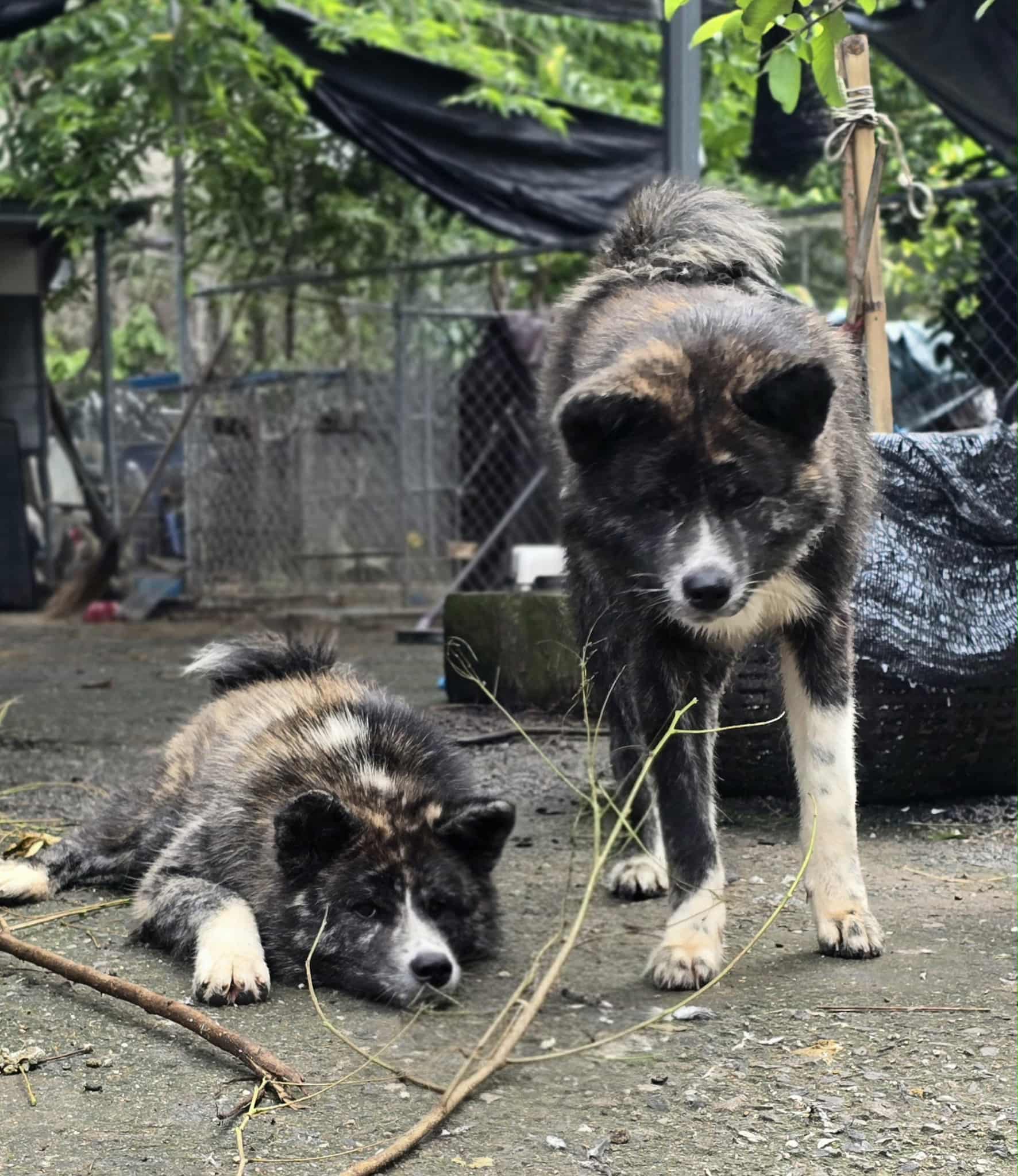
Lately Farm Expo invited me to bring chickens to help promote the event, and the chaos of getting ready — the regular tech partner I'd been carefully aligning with on our future Green Eco and Well Aging projects vanishing on me, the work and money I'd laid out scattering — has left me no time to write anything here. Today, before I get utterly slammed at Farm Expo again, after two shots of light-roast espresso, I'm taking the chance to record a small note about something that's bigger to me than the chickens going out — by a margin I can't measure. My agricultural theory and my Orpington work are also starting to become evident publicly, but for me this little dog observation outweighs all of it.
I can't tell my dogs apart. That's the headline.
I can't tell three of my growing pups apart — they're 7–8 months old, look nearly identical, and the two females among them are so alike I have to read the markings to know which is which. And I'm someone who remembers animal faces more reliably than human ones — people close to me know this well. I can take three lookalike tortoiseshell Holland Lop rabbits and tell each one apart. But I cannot tell Bijin and Anpan apart, because they are that alike.
So what's special about that? Here's the thing.
I've bred something like 50+ Japanese Akita at this point, and I've found their faces are anything but stable — even with line breeding. I've also watched puppies from many serious developmental breeders (the breed-to-sell crowd I don't pay attention to — they're just pumping units, leaning on visuals to draw interest; nothing in there for me to study, and they create future problems for the breed), and I see the same thing: as those puppies mature (actually you can see the start of it from puppyhood), finding one littermate that looks like another is hard to the point of impossible. They tend to look almost exactly like one specific ancestor from the line — pulling that ancestor's genes out clean.
The puppies from the Ango × Toraō line-breeding cross broke that. Three pups came out looking so alike I can barely tell them apart, and they look like both parents at once — a clean 50/50. Big like the sire, dense in the frame, cute in the face like Ango, and the temperament reads like both parents too. The only edge is that the color may run dark, which is correct for Red Brindle — both the brindle stripes and the red ground should be dense, with a clean pattern that doesn't blur, coat long and full without breaking the standard length.
That reminds me of when the twins Sora and Daiginga appeared in Japan — two dogs I saw and was astonished by, because they were like real twins. If memory serves, Sora won a Meiyosho around that period and Sora's descendants have produced Meiyosho gods to the present day. Daiginga is the dog that gets passed around at high prices — even in old age, the price is still seven figures.
The funny part is, with all three of these pups, I've tried to find homes and nobody takes them. Not because they're not good. Because of capacity on our side (only two of us, and we cook for everything — there's a small percentage of commercial feed in the mix, but small — not to cut cost, that word does not exist in my vocabulary, I don't know how to do it, I do this for the maximum effectiveness of what I'm building, and I have yet to find any commercial product, at least that I know of, that performs as well for the animal and the environment as what I currently make) and because of funding — running the household costs around 100,000+ baht a month. I wanted to place them with people who'd have the capacity to care for them, but I've given up on that and will go earn the money to buy more land instead, so they can all live with us.
In the end, this is a note that probably no one will open right now. But someday it might be very useful to whoever is looking for a path to develop a living thing or to build a complete ecosystem on their own land — the way I used to read online notebooks of old Japanese men who have since passed away, notebooks that are now lost to the world.
9/20/2025 — Tamahagane Garden