What You Need Before Raising a Japanese Akita
What to prepare before raising a Japanese Akita — your wits, your wallet, grooming kit, air conditioning, a separate space, and a vet-emergency fund. From the direct experience of a breeder.
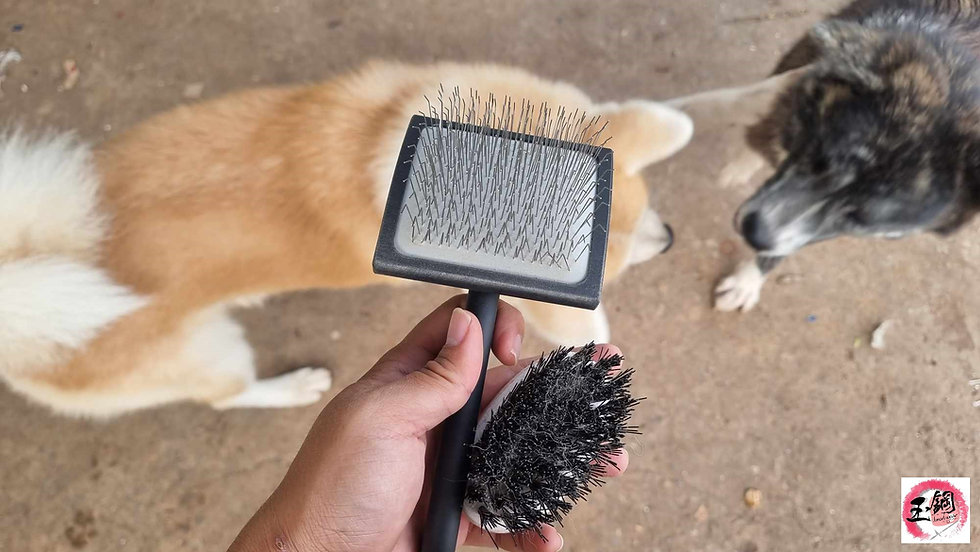
From my own experience — what you should have ready before starting to raise a Japanese Akita. Some people will say "it's just like any other dog." Sure — just like any other dog that happens to have a thick triple coat, is large, and is hard to feed. So today let me lay it out again. If you think your setup is already fine, you can skip this post.
What to know before raising a Japanese Akita
1. Your wits
Yes — your wits. The Akita is a large dog (not as massive as some of the giant breeds, but still), weighing 35–50 kg without being overweight. Even though their exercise needs are modest, the keeper should be in reasonable physical condition. When injuries happen or another dog picks a fight with yours (and just because your dog doesn't start it doesn't mean someone else's won't), you need to be able to handle it.
Socialize the dog from puppyhood (even if your dog has lived in a large pack since birth). Keep yourself physically strong — that part covers a lot.
2. Your wallet
Yes — your wallet. The purchase price will turn out to be the smallest of your expenses, even if you spend 20,000–30,000 baht per dog, or like me, hundreds of thousands or more. It doesn't compare to the ongoing cost — especially when the dog gets sick. Veterinary care is expensive.
No matter how godlike the dog's genetics are, they can still have accidents, fall under stress, or lose nutritional balance to the point of immune crash. Then there's daily feed, deworming every 1–3 months, Nextgard Spectra once every 1–2 months, cleaning agents, and many more recurring costs.
2.1 The grooming kit
You need:
- Wide-toothed comb for removing dead hair
- Pin brush for daily coat conditioning and skin massage
- Boar-bristle brush to polish the coat smooth and stimulate the natural oils
- Slicker brush for managing the dead coat during shedding season
These should be at least mid-grade, both for durability and so they don't injure the dog during use. Or you can use exactly what we use — Chris Christensen, the full set, around 4,000 baht each. Multiply that across however many tools you want.
2.2 Shampoo
Mid-grade or above. Watch out for shampoos that irritate the skin. Pick one focused on coat conditioning — those with oatmeal reduce the incidence of skin problems and stop hair from falling. Ideally, pair the shampoo with conditioner from the same line. We use Chris Christensen as well, the Day 2 Day series with its matching conditioner. The coat comes out beautiful, smells lovely, and your money flies out the window with it.
2.3 Drying equipment
Get a water-blower / high-velocity dryer that can run for over an hour continuously even if you only own one unit. Around 4,000–5,000 baht per unit. Even after towel-drying, drying time per round is still significant (about 30–60 minutes, depending on coat thickness).
You can replace this whole section by taking the dog to a groomer instead — most shops charge 1,500 baht and up depending on the shop. If you have four or five dogs, you'll be smiling sweetly. Personally I chose to do it myself from the start because I don't entirely trust grooming shops. And eventually 1,500 × 16 = 24,000 baht per month — I'll bathe them myself, thanks.
2.4 Air conditioning
Yes — they need air conditioning. They can normally live outdoors, but when the weather is hot — and it gets hotter every year — they need a cooled room to sleep in to prevent heatstroke.
The AC unit's price scales with the space you're cooling — starting around 10,000 baht and up, plus an extra 1,000–2,000 baht on the electricity bill per month, depending on whether the AC was running anyway and whether the dog can live with it.
2.5 Feed
Standard category — but you'll want some variety in the diet if you want the dog in peak condition. We use homemade food alternated occasionally with dry kibble — because we've already cycled through every grade available in Thailand. Some at 4,000–5,000 baht per bag. Nothing matches homemade for any brand we tested. You may want to supplement with fish oil every other month for skin and coat. Dog food doesn't need to be protein-heavy unless activity is very high — what matters most is that the dog actually eats a good amount.
2.6 Leash
For travel, walks, and discipline training. Use a durable grade, and use a neck-fitted leash, not a chest harness — because once you've trained the dog to understand (and you yourself need to understand what you're training, otherwise the dog gets confused and you'll get the opposite of what you want), a neck-fitted leash won't be doing much restraining.
A chest harness, on the other hand, lets the dog not feel any restraint — which means they stay just as stubborn as ever, sometimes worse, because they're comfortable and can even strut. Think of the dog whose owner tries to stop them and the dog acts even more cocky, then when finally let loose runs away scared — that kind of dynamic. On top of that, a chest harness creates skeletal distortion over time — the dog ends up walking with the front legs splayed outward. That's a long-term disaster.
2.7 Separate housing
If your home has things you care about — when Kurumi was young she chewed through the household electronics: headphones, microphone, keyboard, mouse — adding up to roughly 50,000 baht. She also killed a bonsai of mine that ran in the 200,000+ baht range, plus several hundred thousand more in other valuable plants from that period. The first puppy litter chewed through our caladium collection — roughly a million baht.
If you have things like this in the house and don't want to lose them, set up a separate living space (with air conditioning) or a sturdy crate kept in an air-conditioned room when no one is around to watch.
2.8 Emergency vet reserve
Accidents happen everywhere — that line never stops being true.
- Usagi once ate soil from leaves used as fertilizer, got diarrhea, threw up. About 5,000 baht spent (before we discovered she'd recovered on her own while we were waiting for treatment — money spent before any actual treatment was needed).
- Hana got bitten by a centipede during her first litter. Chest tissue inflammation, four months of treatment, about 70,000 baht.
- Toraō, Jomusuke, Shime, and Junjunmaru caught an Indian-region protozoan strain from beef they ate. 120,000 baht total (about 30,000 per dog — heavy because it had to be paid all at once).
Full vaccination doesn't help with these kinds of illnesses.
And if you happen to get a dog with poor bloodline, brace yourself — it can be far worse. (I saw this with my own eyes while bringing Hana for treatment — there was a dog with low platelets, requiring weekly blood transfusions. About two months in, the dog didn't make it.)
In summary
That's all I can think of for now — I'll come back and add to this when more comes to mind. I hope anyone considering a Japanese Akita can use this as their own checkpoint. Not everyone needs to be ready on every item from day one — but every item will come knocking in the long run. Seeing the full picture before deciding protects both the dog and yourself.
— Mai of Tamahagane Garden