Breeder's Diary, EP.5 — Inside a Chicken Feather: Two Layers, Two Pigments, One Red Leak
What I just figured out about feather color in Black Orpington. Eumelanin and Pheomelanin sit in two layers; Blue dilution leaves gaps where the red below shows through. Plus a second cause that fades on its own.
{/* og-image source: https://static.wixstatic.com/media/2b52f0_84d0e9955b1e4e50818de7f90adad7c4~mv2.jpg */}
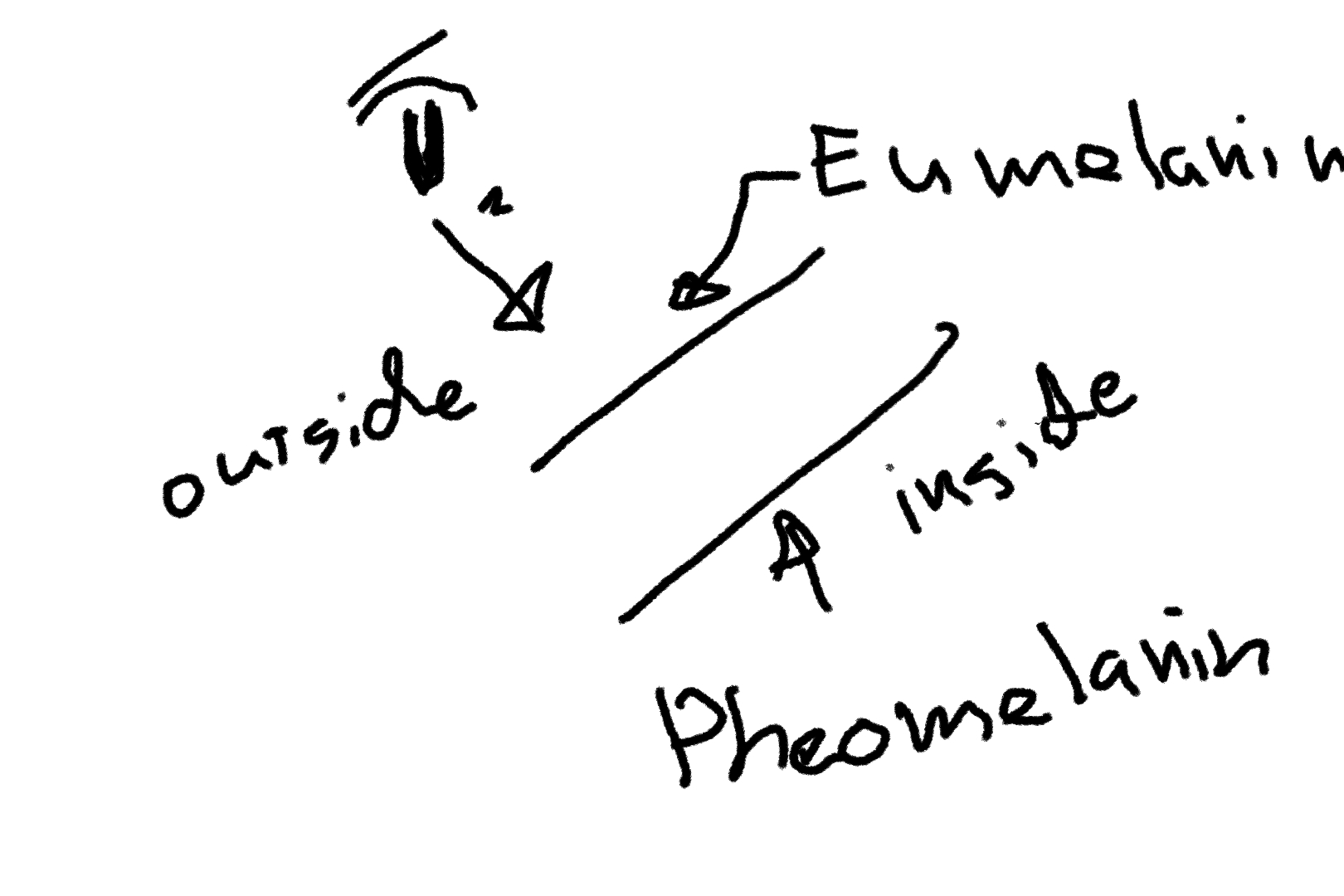
Today's a bit unusual — I'm posting a drawing I made to explain something I just figured out about chicken feathers. I've been trying to remove red from my black Orpington and kept finding that, at the end, there's still a gap somewhere that lets red leak through (Red Leak). So I went looking for a chicken with no red gene at all, and that search ended at this discovery.
Chicken feather color has two visible layers that determine what we see with the naked eye: a black-controlled outer layer made of Eumelanin, and a red-controlled inner zone called Pheomelanin. If you can't picture it: assume every chicken is red on the inside (assuming the Gold gene — the one that produces red and gold in Buff). There are two main colors at this layer if no further mutation is overlaid — Gold and Silver (Silver comes from Pheomelanin production being suppressed). This locus influences breeding in a sex-linked pattern.
So a chicken showing red on the feathers — in the cases I've observed — comes down to two causes:
1. Eumelanin leakage (Red Leak / White Leak — depending on what's at the S-Locus / Pheomelanin slot)
The black layer is incapable of fully covering the red below. This happens in chickens that came through a not-dense-enough Blue line. Yes, in theory Black × Blue = 50% Blue + 50% Black — but in practice (across many, many chicks, both this case and the other below) what I see is: a Black diluted by Blue, even though it's classified as the same color, ends up as a Dilution that causes Incomplete Dominance — the cover that doesn't cover all the way. The result is a feather that's only deeply black at the edge, not solid black across the whole shaft. That's exactly where the red — the Pheomelanin sitting underneath — shows through the gaps.
2. Oxidation tips (juvenile chicks growing too fast)
Especially in Orpington, the chick grows feathers faster than its Eumelanin production can keep up, so the Eumelanin can't cover the new feather in time. The result is small red tips along the feather. This kind fades on its own at the first molt. If this is what's happening, you don't have to do anything — just wait for them to grow up.
Those are the two causes. The fix, depending on the case:
- Use a Black with no Red Leak as the introduction sire, provided your chicken doesn't have a major leak — i.e. provided the Pheomelanin hasn't been amplified by line-fixation into Autosomal Red or the Mahogany gene that most breeders know as the deep-red bird.
- If you keep breeding "leaky" birds together, you eventually arrive at a chicken that's solid deep red with some black tail and some black wing edges. (If you're not picturing it: think Rhode Island Red.)
Bringing a Black with no Red Leak into the mix amplifies the Melanizers process — the actual blackening pigment overlay on chicken feathers.
— Tamahagane Garden